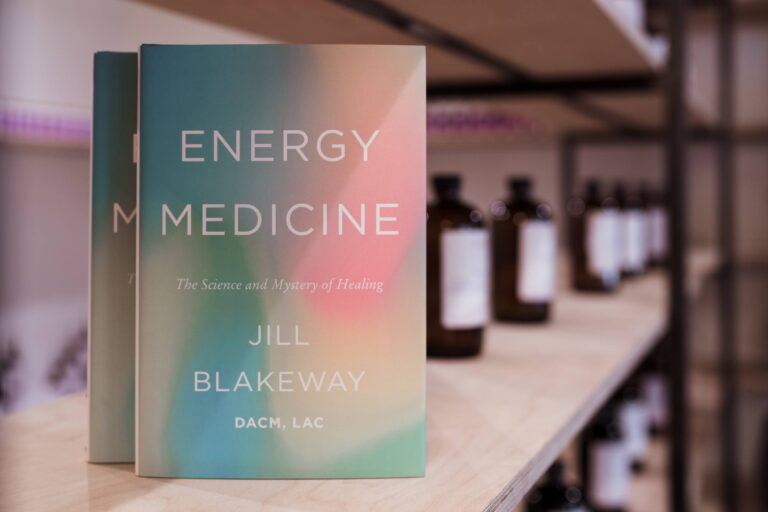
One of the questions I get asked most often in the treatment room is some version of: “How does acupuncture actually work?” For thousands of years, Chinese medicine has answered that with the concept of Qi — a vital life force moving through a network of meridians that connect every part of the body. I’ve relied on that framework in my own practice for over two decades.
What’s exciting now is that modern research is starting to identify physical structures that may help explain how that communication actually happens.
Rather than treating Qi as something abstract, emerging science is exploring the possibility that the body’s connective tissue functions as an intricate communication network — one that behaves remarkably like the meridian system described in ancient texts.
YIN PROVIDES THE STRUCTURE FOR YANG
In Chinese medicine, Qi is often associated with yang, the dynamic qualities of movement, activity, and transformation. But movement doesn’t exist without structure. Yang relies on yin, the nourishing and supportive aspect of the body that provides the framework through which movement can occur.
Think of electricity traveling through a circuit. The current can’t exist independently; it needs a conductive pathway. The movement of Qi works the same way, it depends on the body’s underlying structure.
Practitioners have long understood that Qi travels between points along defined pathways. Large Intestine 4 on the hand and Large Intestine 15 on the shoulder, for example, sit on the same meridian. These pathways were mapped long before modern anatomy existed, and researchers are now asking whether the body’s connective tissue is the physical network behind them.
CONNECTIVE TISSUE IS MORE THAN STRUCTURAL SUPPORT
Research from Helene Langevin at the University of Vermont has brought new attention to connective tissue’s role in the body. Within this tissue are specialized cells called fibroblasts – dense, star-shaped cells that change dramatically when stimulated, expanding into broad, sheet-like forms. Even more strikingly, this change doesn’t happen in isolation: as one fibroblast shifts shape, neighboring cells respond too, creating a ripple effect through the surrounding tissue.
This tells us connective tissue isn’t just passive scaffolding. It’s an active, responsive network that can transmit mechanical information across the body.
WHAT THIS MEANS FOR YOU
For those of us who practice East Asian medicine, this research is exciting because it echoes what our field has observed clinically for centuries. When I treat a patient, I’m working with the understanding that the body is one interconnected system, and it’s genuinely gratifying to see modern physiology start to describe the same thing in its own language.
This doesn’t mean science is “proving” Qi or replacing thousands of years of clinical experience. It means we’re getting a fuller picture — one where ancient observation and modern biology can sit side by side.
If you’re curious how this connects to your own care, it’s something I love talking through with patients at Yinova.